


Flying Car-The future trend
Future flying machines


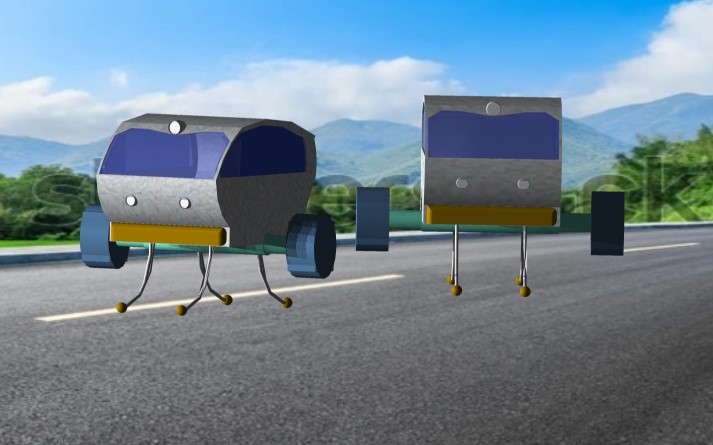
Future road vehicles can fly in sky
The next leap beyond drones and electric aviation is personal flying machines powered by clean, scalable electromagnetic propulsion.
Everyone dreams of travel, yet traditional transportation often involves navigating through obstacles that lead to wasted energy and time. Imagine the convenience of moving freely without barriers!
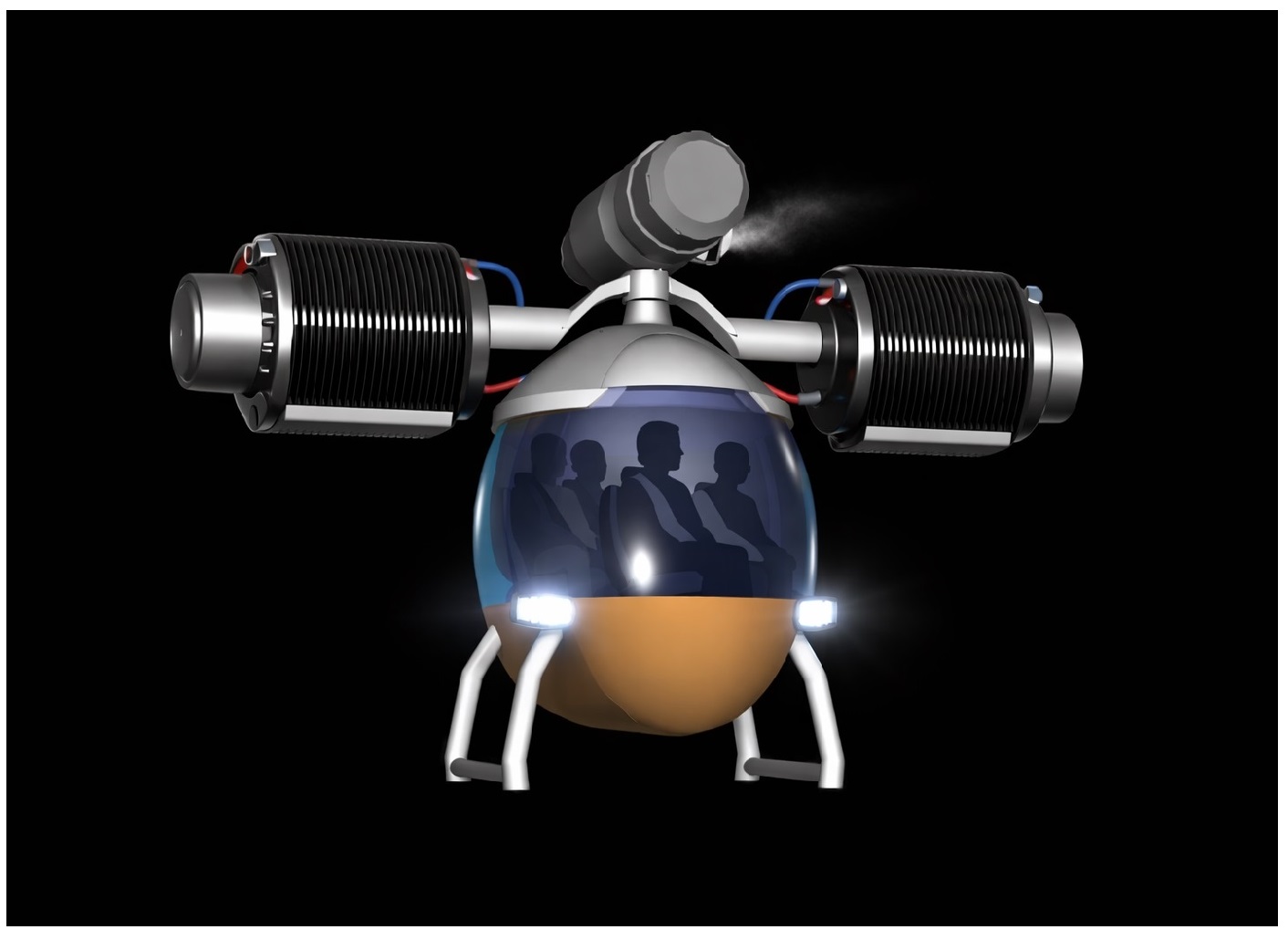
We present the perfect solution: sky travel via electromagnetic flying cars. This innovative mode of transportation revolutionizes how we think about driving and flying. Flying cars take up only the space of a standard vehicle, meaning they require no extra parking area. They can be parked virtually anywhere, even on unprepared land.
Designed without propeller blades and exposed moving parts, these flying cars ensure safety and efficiency. Moreover, they come in both autonomous and self-driven models, providing flexibility for every user.
A flying car is not just a helicopter; it's a versatile vehicle that excels both on the road and in the air. With vertical takeoff and landing (VTOL) capabilities, this remarkable personal air vehicle redefines convenience and accessibility in transportation. Embrace the future—travel smarter and faster!
The flying cars powered by electromagnetic thrusters embodies innovation and a leap towards cleaner, more efficient travel, suggesting a world where personal mobility is no longer confined to roads. Its ability to take off and land on any surface hints at a future where urban and even rural environments are easily navigable, potentially reducing the need for extensive infrastructure like roads and airports. The remote control or steerable arms suggest ease of use and accessibility, making personal air travel more commonplace.
It taps into the long-held dream of flying cars, symbolizing freedom and the overcoming of physical limitations. The concept also speaks to a desire for cleaner technology, with the electric power generation suggesting a commitment to environmental responsibility. This technology can improve our lives and our world.
.gif)
Patent App :LK/P/1/22948- Sri lanka
Flying Vehicles in the Foreseen Future
Imagine a world where travel is seamless and efficient, allowing
us to reach our destinations without the frustrating obstacles of
traditional roads. Land travel often forces us to contend with detours,
traffic, and elevation changes, wasting precious time and energy.
What if we could soar directly to our destinations in the sky?
Enter the revolutionary electromagnetic flying vehicles, the solution
for modern transportation. These cutting-edge vehicles are powered
by turboshafts, internal combustion engines or a combination of turboshafts
and internal combustion engines, alongside rechargeable batteries
that make them not only innovative but also environmentally friendly.
Flying cars occupy just as much space as current automobiles, eliminating the need for additional parking areas. They can land anywhere, even on unprepared surfaces, making them incredibly versatile.
Think of a flying car as the ultimate hybrid; it functions as both a road vehicle and an aircraft without the danger of exposed propeller blades. The propellers are expertly shielded to ensure safety and durability. With Vertical Take-Off and Landing (VTOL) capabilities, these personal air vehicles come in both autonomous and manual driving options.
The future of flying cars is not just a dream. It's a remarkable reality on the horizon. Embrace the possibilities of efficient travel and a new era of transportation!
Electromagnetic Thruster Flying Machine
This excellent condition will enable to avoid road travel and more
credibly sets realistic expectations.
Operational Profile
This flying machine is designed for short distance travel, with a
maximum endurance of less than two hours per flight. The compact electromagnetic
thruster system enables rapid lift and maneuverability, while the
vertical landing gear allows the craft to land safely on any terrain
in case of emergency. It will fly at low attitude able to land any
place in an emergency.
By limiting flight duration, the design prioritizes safety, reliability,
and redundancy over long range performance, making it ideal for urban
mobility, emergency response, and short range commuting.
This aircraft is designed urban commuting, emergency medical transport,
and adventure tourism.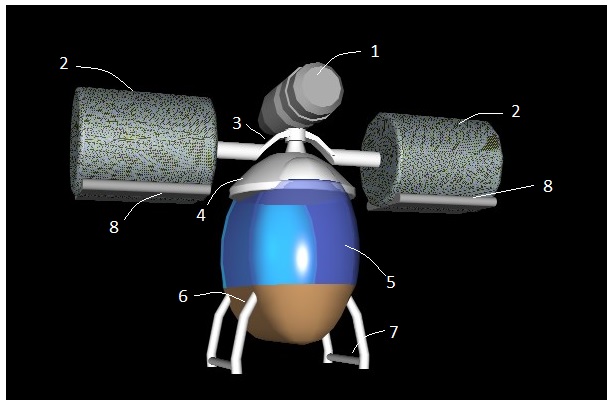
This is "A compact vertical lift flying machine powered by electromagnetic
thrusters(2). The Flying machine consists - turboshaft generator(1),
conical fuel tank(4), fuselage(5), and landing gear(7) - delivers
balanced thrust, efficient cooling, and stable VTOL operation without
traditional wings or propellers."
The design integrates a vertically stacked architecture that optimizes
both stability and efficiency. At the top sits the power generator(1)
Turbo shaft, isolated to minimize vibration transfer and positioned
to allow heat dissipation upward. Flanking the generator are dual
electromagnetic thrusters(2) mounted on rotary bases(3), providing
balanced lift and enabling thrust vectoring for directional control
without reliance on aerodynamic surfaces. Directly below the generator,
the conical fuel tank(4) acts as a transitional structure, maintaining
mass balance while simplifying cooling pathways and energy routing.
The fuselage(5) beneath houses is avionics provided with luggage(6)
space. Control systems, and structural reinforcement, forming the
aerodynamic shell of the craft. The landing gear at the base ensures
stable vertical takeoff and landing, absorbing ground impact and supporting
the vehicle's weight during rest.
The lateral thrusters(2) deliver symmetric lift and maneuverability.
The result is a compact, self stabilizing flying machine concept designed
for efficient VTOL operation without wings or propellers.
The cooling system, featuring radiators (8) for the EM thrusters,
is mounted beneath two cylindrical barrels (2) and operates independently.
This design accommodates a pilot and four passengers, with additional
space (5) for baggage (6). Powered by a 320 kW turboshaft engine,
it has an empty weight of 75 kg and a gross weight of 1,500 kg. The
two thruster modules (2) each house six linear motors, producing 7,000
newtons apiece and delivering a combined thrust of 14,000 newtons
to the vehicle.
This design example provides space (5) for a pilot and 4 passengers,
plus baggage space(6). It is powered by a 320 kW turboshaft engine,
with an own weight of 75 kg and a gross weight of 1500 kg. The two
thruster modules(2) carry 12 linear motors producing 7000 newtons
each, resulting in 14,000 newtons of force to the flying vehicle.
Although the system challenges to consider takeoff energy, key benefits
and structural impacts of this type of transportation system:
Benefits Travelers by point-to-point travel: Bypasses traditional
ground-level grid systems entirely.
Although the system challenges to consider takeoff energy:
Fuel and Cost EfficiencyLine-of-sight routing: Eliminates extra mileage caused by detours and grid systems.
Constant speeds: Avoids the fuel-wasting "stop-and-go" patterns of city traffic.
Lower idle times: Reduces wasted energy spent waiting at intersections or bottlenecks.
Massive scaling potential: Saves significant operational costs .
Dynamic routing: Uses three-dimensional airspace to find the absolute
shortest path.
Time savings: Eliminates delays caused by ground traffic congestion.
Impact on Infrastructure:
Zero asphalt: Reduces the financial cost of paving and maintaining
roads.
Space reclamation: Converts urban parking lots into green spaces or
housing.
Minimal footprint: Requires only localized launch and landing pads
(vertiports).
Next: Electromagnetic vehicles in public transport.

For more details Contact : Leelananda Jayasuriya
E-mail : leel6391@yahool.com
Local Business Directory, Search Engine Submission & SEO Tools